

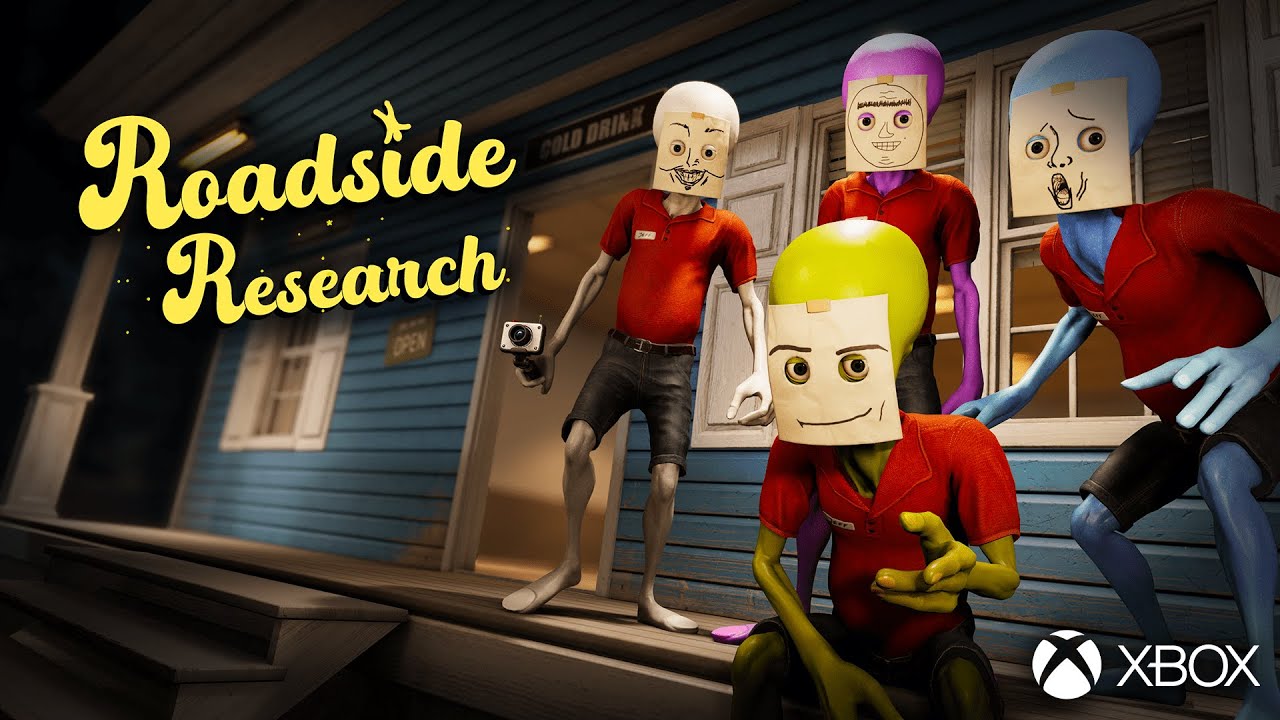
Roadside Research arrives on Xbox as one of those curious, rough‑edged Game Preview titles that immediately sparks intrigue. Its premise is simple but appealing: explore these strange creatures called Homo Sapiens, via the medium of a run-down Gas Station and convenience store. Investigate strange objects, and piece together environmental clues in a world that you don’t fully understand.
But for all its charms, the game is currently held back by control issues, missing features, and a general lack of refinement that makes it feel more like a prototype than a fully playable experience.
A Promising Concept with it’s tongue firmly in its cheek.
The strongest element of Roadside Research is its tone, which is pedestrian with just enough quirky touches to keep you engaged. There’s a sense of isolation with the game set at a backroads gas station that works in the game’s favour, creating a mood that’s equal parts eerie and blind panic. You’re not fighting enemies or racing against time; you’re simply trying to serve the local creatures for their needs, understand the creatures them and why they travel around in these strange, metal boxes on axles.
This games pace is refreshing in a landscape dominated by high-intensity action games. The game is frenetic in single player (the game becomes a lot easier in co-op), where you have to pump gas for customers, serve in the shop, clean the floors, clean the toilets, as well as collect examples of humankinds habits and detritus to be analysed and get points to upgrade your abilities and those of the gas station. You are also trying to stop the customers from becoming suspicious of you and your kind, so mopping up strange, coloured puddles on the floor is commonplace.

The Controls: The Game’s Biggest Obstacle
The most immediate and unavoidable problem is the control scheme. Even by Game Preview standards, the controls are shockingly unrefined. Movement feels stiff and unresponsive, subtle nudges on the stick don’t translate into subtle movement; instead, the character lurches or overshoots, making precise navigation frustrating.
This lack of fine control becomes especially noticeable when interacting with objects. Picking things up and examining them feels clumsy, as if the game is fighting your inputs. There’s no sense of tactile feedback or smooth interaction—just a series of awkward motions that break immersion and make simple tasks feel like chores.
Its almost as though the game was ported directly to Xbox, but the controls were still configured for a mouse.
The absence of any form of auto-lock or contextual assistance compounds the issue. In a game built around manipulating objects and environmental details, you’d expect some kind of soft targeting, magnetism, or snap-to interaction to help guide the player. Instead, you’re left wrestling with the camera and movement controls, trying to line up your character with tiny interaction points that don’t always register.
The result is a constant low-level irritation that undermines the game’s otherwise thoughtful pacing. Instead of feeling like a careful investigator, you feel like someone trying to operate machinery with oven mitts on.

Gameplay systems that need More depth
Beyond the controls, Roadside Research suffers from a lack of mechanical depth. The core loop—running around desperately, trying to study the humans whilst not arousing any suspicion — has potential, but the game doesn’t yet offer enough variety or complexity to keep it engaging over longer sessions.
Visuals and Performance
Visually, Roadside Research is modest but effective. The environments are simple, but the art direction carries them. It’s not a graphical showcase, but it doesn’t need to be.
Performance on Xbox is generally stable, though the occasional hitch or stutter appears when the game moves from day to night. Nothing game-breaking, but enough to remind you that this is still very much a work in progress.
There was some confusion when I found my save file would not load. No error messages, no audio feedback, nothing. It turns out that you need to name your gas station by pressing Y on the load screen, otherwise the save simply not work.
It is an obvious attempt to allow players to identify one save game from another, but its clumsily implemented and whilst not game-breaking, this can cause problems for players.
Audio: Sparse but Atmospheric
The audio design is minimalistic, relying on ambient noise rather than music. This works in the game’s favour, reinforcing the sense of isolation. The distant wind, the crunch of gravel underfoot, and the occasional environmental creak all contribute to the mood. However, like the rest of the game, the audio feels incomplete—functional, but not yet fully realised.
Potential vs. Reality
The most frustrating thing about Roadside Research is that the potential is obvious. The concept is strong. The world feels like it could be incredibly good fun, but the rough edges stop us from seeing the shining diamond within.
Game Preview titles are allowed to be in various stages of refinement, but they still need a solid foundation. Right now, the foundation of Roadside Research is shaky, the controls need a complete overhaul, the interaction system needs refinement, the gameplay loop needs expansion and the game needs more features—more tools, more mechanics, more reasons to keep playing.
If the developers commit to improving these areas, Roadside Research could evolve into a genuinely unique and enjoyable experience. But in its current state, it feels like an early prototype rather than a preview of a near-finished game.

Verdict
Roadside Research is a game with a unique identity and a compelling atmosphere, but it’s held back by unpolished controls, missing features, and a lack of mechanical depth. As a Game Preview title, it has room to grow, and the potential is absolutely there. But right now, it’s difficult to recommend unless you’re extremely patient or deeply curious about its concept.
For players willing to tolerate rough edges and provide feedback, it may be worth exploring. For everyone else, it’s a game to keep an eye on rather than dive into immediately.
Overall
-
CX Score - 50%50%
Summary
Pros
- A genuinely original premise with a great tone — the idea of studying humans as strange creatures is clever, and the eerie‑but‑playful atmosphere at the lonely gas station gives the game a distinctive identity.
- A refreshing gameplay pace — instead of combat or timers, the loop focuses on serving customers, observing behaviour, and managing chaos, which feels different from most modern releases.
- Strong environmental mood and audio — the sparse sound design, isolated setting, and simple but effective art direction create a memorable sense of place.
Cons
- Deeply unrefined controls — movement is stiff, object interaction is clumsy, and the lack of soft‑locking or contextual assistance makes basic tasks frustrating. A decent control system would increase the score.
- Shallow gameplay systems — the core loop shows promise, but there isn’t enough mechanical depth or variety yet to sustain long sessions.
- Rough edges and missing features — save‑file quirks, occasional performance hitches, and generally prototype‑level polish make the experience feel unfinished.