

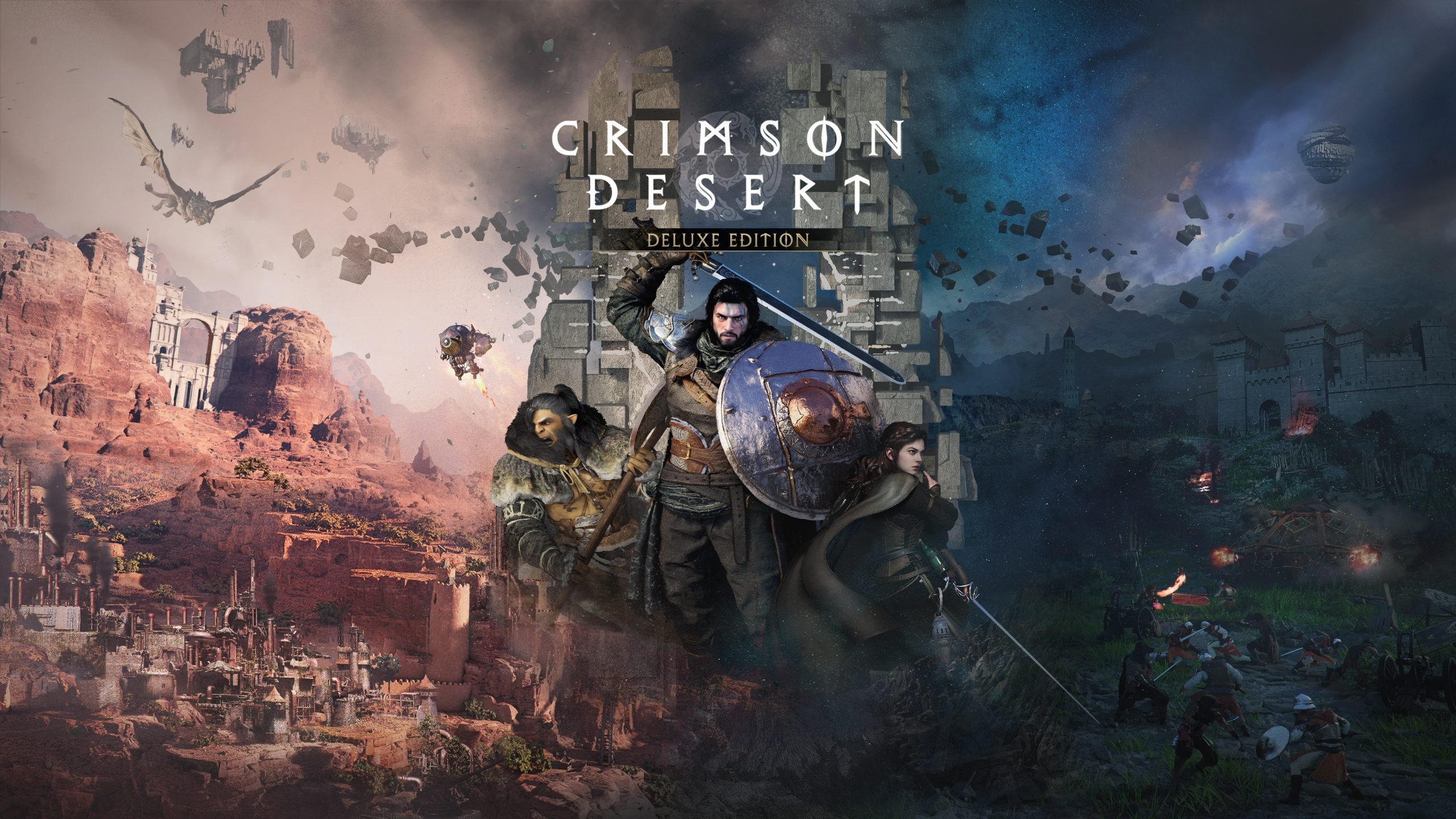
Before we dive in, a quick note: Crimson Desert is a hugely ambitious game with astonishing breadth and depth. In a world this vast — where every corner hides new quests, secret lore, and dynamic encounters — a single review can only scratch the surface. Even now, as I write these words, there are countless hours of playtime still ahead, and discoveries yet to be made.
So consider this a review in progress — a snapshot of a journey that’s still unfolding, an experience that keeps rewarding time and attention, and one that constantly evolves the longer you explore.
A World Crafted to Be Explored
Right from its opening moments, Crimson Desert announces its intentions. This is not a trimmed‑down, hand‑held wander through an open world — it’s an expansive, living, breathing continent full of conflict, culture, and colour. From sun‑bleached deserts to lush forests, towering outposts to hidden caves, the world design is nothing short of breathtaking.
The landscapes have an almost painterly quality: dust swirls in golden light, distant silhouettes crest on sandy horizons, and cities pulse with life — merchants, guards, and everyday travellers all bringing the world to life around you.
It gives off the kind of “everywhere you look there’s something worth seeing” energy that keeps you exploring long after you planned to stop. On Xbox Series X|S this world runs beautifully, with strong draw distances, detailed environments, and atmospheric lighting that makes each region feel uniquely alive.
Exploration isn’t just aesthetic, either — it’s rewarding by design. Hidden quests, rare monsters, side stories, and mysterious ruins are tucked away in places few will stumble upon without curiosity. And that sense of discovery keeps the game fresh.
Mission Clarity: A Love‑Hate Relationship
Here’s a big part of the experience that’s earned some mixed feelings: Crimson Desert doesn’t always do a great job of explaining its missions.
That’s not to say quests are obtuse — but the way the game communicates objectives can be deceptively subtle. Some main missions launch you straight into dialogue with little navigational guidance. Side missions sometimes let you wander without clear direction, trusting you to piece things together from environmental cues and context. Inventory screens and quest logs can feel sparse when you’re trying to figure out your next step.
This lack of hand‑holding can be frustrating at first, especially if you’re used to games that map out every objective with laser precision.
That said — and this is important — the missions themselves are seldom dull. Far from it. They’re packed with narrative texture, branching paths, tough choices, and outcomes that matter. Side quests often unravel into stories worth experiencing in their own right, rather than just “fetch X for Y.”
In a way, the unclear mission markers push you to pay attention — to really live in the world rather than cruise through it. It’s a bold design choice, and while it won’t land perfectly for everyone, it does help make the world feel more organic and alive.
Controls and Combat: Deep, Yet Demanding
Crimson Desert’s combat and control system carry that same dual personality: rich and rewarding, but sometimes demanding more precision than you expect.
Swinging your weapon, blocking attacks, chaining combos, mounting creatures, and casting abilities all feel weighty and responsive — when you understand the rhythm. But the learning curve can be steep, especially early on. Movement animations, dodges, and attack timings don’t always feel immediately intuitive, and there are moments when the interface doesn’t reinforce the mechanics as clearly as it should.
Still, once you find your groove — once you learn to read enemy patterns, balance stamina, and combine attacks effectively — combat becomes deeply satisfying. Larger encounters feel tactical rather than chaotic, and boss fights demand strategy over button mashing.
On Xbox Series X|S the controls respond well, and the game supports an accessible range of input styles — whether you prefer the standard controller or something more advanced. The tactile feedback during combat adds weight to every hit, which helps deepen engagement once the basics click.
A Narrative Woven Through Conflict and Character
One of Crimson Desert’s greatest strengths is how its story unfolds through character interaction.
This isn’t a barebones fantasy world — it’s one shaped by conflict, social tension, and competing interests. The game gives you moments to forge alliances, make morally grey decisions, and confront factions that have their own agendas. NPCs aren’t cardboard cutouts; they have motivations, grudges, and histories that affect how they interact with you.
It’s storytelling that respects your intelligence, often pushing you to make choices without spelling out consequences. That ties neatly into the mission structure: because objectives aren’t always clearly pointed out, you’re left to think, observe, and deduce.

Side Missions That Surprise and Reward
In many open-world games, side missions feel like filler — a way to pad playtime without offering much substance. Crimson Desert mostly avoids that trap.
Side missions often introduce interesting characters, unexpected plot twists, and unique mini‑stories that feel like organic parts of the world. Whether you’re tracking bandits, delivering supplies to struggling settlements, or mediating disputes between rival factions, there’s a sense that every mission has a purpose.
That doesn’t mean every side quest is a masterpiece, but enough of them carry their own charm, challenge, and narrative weight to keep you invested.
It’s this variety — and the way these missions consistently feel fresh — that keeps you coming back, even when the story’s main thread temporarily slows down.
Audio‑Visual Identity: A World Worth Seeing and Hearing
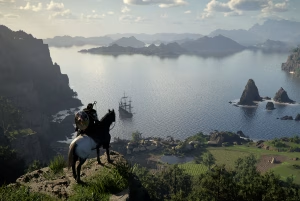
Visually, Crimson Desert is stunning. From sandy dunes to lush forests, sweeping valleys to fortified cities, the world feels diverse, alive, and surprisingly cohesive. The lighting and environmental effects — dust motes in the sun, storms rolling across plains, fog lifting at dawn — give every region its own mood.
On Xbox Series X|S, the game holds up well technically, with strong performance and minimal noticeable technical issues during exploration and combat.
The audio similarly complements the experience beautifully. Music swells appropriately during key moments, ambient sounds like wind and wildlife enhance immersion, and the voice acting generally feels robust — emotional when needed, understated when appropriate.
Together, these elements help establish the game’s tone: grand, mysterious, and always worth exploring.
Where It Could Improve
Even with its many strengths, Crimson Desert isn’t flawless.
- Mission Clarity: As noted earlier, the lack of clear guidance can slow progression and create confusion.
- Control Precision: Combat and controls demand patience and adaptation, which might feel frustrating for some players early on.
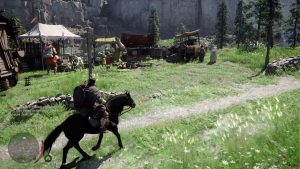
- Pacing Variability: The sprawling world sometimes feels slow between key story beats.
None of these are deal breakers — but they are worth noting for players deciding when and how to dive into this world.
Verdict
Crimson Desert is an ambitious, expansive RPG that rewards curiosity, exploration, and patience.
It doesn’t always hold your hand. It doesn’t lay out every objective in neon signs. Instead, it invites you to think, to explore, and to become truly immersed in a world that feels alive and unpredictable.
Whether you’re uncovering a hidden quest in an abandoned outpost, negotiating with wary factions, or watching the sun set over a candlelit desert city, there’s a constant sense of discovery that keeps you invested.
For players who love deep worlds, layered storytelling, and the freedom to carve their own path, Crimson Desert offers a rewarding experience — rough edges and all.
Crimson Desert is an ambitious journey worth taking — a living world with endless stories to uncover, even if it doesn’t always hold your hand.
Overall
-
CX Score - 80%80%
Summary
Pros
- Stunning, wide‑open world that rewards exploration
- Fresh, engaging missions and side content
- Deep narrative with meaningful choice
- Tactical combat that feels rewarding once mastered
- Strong audio‑visual atmosphere on Xbox Series X|S
Cons
- Mission objectives can be unclear and poorly explained
- Control and combat have a learning curve
- Pacing occasionally uneven