

A Familiar Foundation, Sharpened but Unchanged
There’s a confidence to MotoGP 26 that’s immediately noticeable. From the moment you hit the track, it delivers exactly what you expect from the series—speed, precision, and a constant need for control at the absolute limit of traction.
But that familiarity is also where the conversation begins and ends.
Because while MotoGP 26 is a refined and enjoyable racing experience, it rarely moves beyond refinement. Instead, it continues the series’ long-standing trend of iteration over innovation, tightening existing systems rather than meaningfully evolving them. The result is a game that feels polished and consistent—but also safe.
It knows what it is. It just doesn’t try to be more.
Riding That Feels Sharper, But Not Transformative
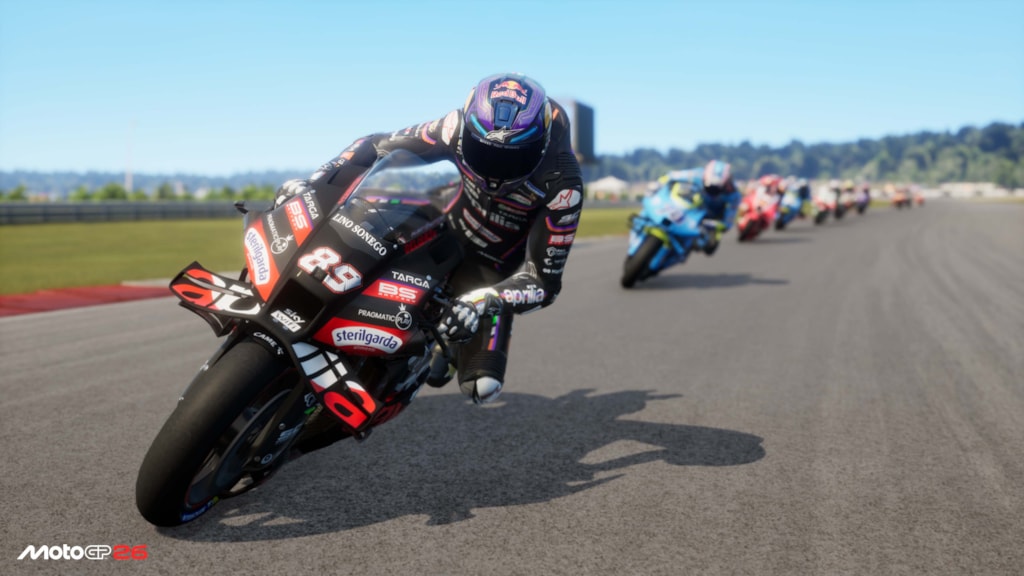
The most notable improvement this year comes from the riding model. The updated physics system places more emphasis on rider movement and body positioning, creating a stronger sense of connection between rider and machine.
Cornering feels more deliberate. Braking requires greater discipline. And throttle control becomes something you constantly manage rather than instinctively apply.
When everything clicks, it’s genuinely rewarding. A perfect lap—where you balance braking, lean angle, and acceleration—feels earned in a way that captures the tension of real MotoGP racing.
However, while the improvements are noticeable, they don’t fundamentally change the experience. The physics feel refined, but not reinvented. The core identity of the handling remains very close to previous entries, meaning experienced players will adjust quickly without ever feeling like they’re learning something entirely new.
It’s better—but only incrementally.
Accessibility That Keeps It Open to Everyone
Despite its simulation lean, MotoGP 26 continues to prioritise accessibility alongside depth. Multiple riding assists and control styles allow players to tailor the experience to their comfort level, whether they want a more forgiving arcade feel or a stricter, more technical simulation.
This flexibility is one of the game’s strongest design elements.
It ensures that newcomers aren’t overwhelmed, while still giving experienced players enough depth to engage with the finer details of bike handling and race craft. The learning curve is present, but it never feels hostile.
It’s a system designed to include rather than exclude—and it works.
The Official Season – Accurate, Structured, Expected
As expected, MotoGP 26 includes the full official 2026 season, complete with all riders, teams, and circuits. The presentation of the championship is clean and functional, offering a structured recreation of the real-world calendar.
Each track brings its own identity, and the variety across the season helps maintain engagement across long play sessions. From flowing high-speed layouts to tight technical circuits, the challenge remains consistent throughout.
There is also a sense of evolution within the grid itself, with rider performance shifts adding a small layer of unpredictability to race outcomes.
But while all of this adds authenticity, it also highlights a recurring issue: it’s expected. The series has reached a point where accuracy is a baseline requirement rather than a standout feature.
Career Mode – Depth That Doesn’t Evolve Enough
Career mode remains the central pillar of MotoGP 26, and while it introduces new layers of presentation and interaction, it ultimately struggles to move the experience forward in a meaningful way.
There are attempts to add context through media interactions, team discussions, and career progression systems that give your journey more structure. On the surface, it feels more immersive than before.
But underneath that structure, the loop remains largely unchanged.
Race weekends follow a predictable rhythm, and over time, repetition begins to set in. While the authenticity of the structure is appreciated, the lack of meaningful variation makes long-term engagement feel predictable rather than dynamic.
It’s a solid system—but not an evolving one.

Race Off Modes – Interesting, But Not Essential
The return of Race Off content adds alternative bike disciplines and side events designed to break up the core racing structure. These modes provide variety and can be fun in short bursts, offering a change of pace from the intensity of full MotoGP races.
However, they don’t integrate deeply enough into the broader experience.
Instead of feeling like meaningful extensions of the core career, they exist more as optional diversions. Once the novelty wears off, their impact on long-term progression feels limited.
There’s potential here—but it remains underdeveloped.
Presentation – Clean, Fast, and Familiar
Visually, MotoGP 26 delivers a polished and consistent presentation on Xbox Series X. The sense of speed is strong, with bikes feeling fast and responsive as they move through each circuit.
Tracks are well detailed, lighting is effective, and the overall atmosphere captures the intensity of professional motorcycle racing.
But much like the rest of the game, it feels iterative rather than transformative. There’s no major visual leap forward, no standout moment where the presentation significantly evolves compared to previous entries.
It’s clean. It’s stable. It’s familiar.

Multiplayer – Where the Energy Peaks
Multiplayer remains one of the most engaging parts of MotoGP 26. Full-grid racing creates chaotic, competitive moments where every decision matters and every mistake carries consequences.
Racing against real players introduces unpredictability that single-player often lacks. Overtakes feel more intense, mistakes feel more costly, and victories feel genuinely earned.
It doesn’t redefine the game—but it does elevate it.
Where It Holds Back
Despite its strengths, MotoGP 26 is ultimately held back by its reluctance to evolve beyond its established formula.
The riding model is improved, the structure is refined, and the presentation is polished—but the overall experience still feels familiar in almost every respect.
Career mode repetition becomes more noticeable over time, and while the core racing remains excellent moment-to-moment, the surrounding systems don’t do enough to sustain long-term excitement.
AI behaviour can also be inconsistent at times, occasionally breaking immersion during races.
None of these issues ruin the experience—but together, they reinforce the sense that this is a game playing it safe.
A Racer Defined by Precision
At its core, MotoGP 26 is about precision.
It’s not about chaos or spectacle. It’s about control, timing, and execution. Every corner demands focus, every braking point matters, and every mistake is yours to correct.
When it works, it delivers some of the most satisfying racing moments in the genre.
But those moments exist within a framework that rarely evolves around them.

Final Thoughts
After extended time with MotoGP 26 on Xbox Series X, it’s clear this is a game built on refinement rather than reinvention.
It improves the riding experience, delivers a polished presentation, and remains consistently enjoyable for fans of the series. At its best, it captures the tension and precision of MotoGP racing with confidence.
However, it also highlights the limitations of its approach.
Because while it is refined, it is also familiar. While it is polished, it is also predictable. And while it is enjoyable, it rarely feels like it’s pushing the series forward in any meaningful way.
Still, when you’re locked into a perfect lap, everything fades away except the track ahead.
And in those moments, MotoGP 26 delivers exactly what it sets out to do.
Overall
-
CX Score - 80%80%
Summary
Pros
- Refined and responsive riding physics
- Strong sense of speed and control
- Full official 2026 season with all riders and tracks
- Accessible without losing depth
- Competitive and engaging multiplayer
Cons
- Limited innovation over previous entries
- Career mode becomes repetitive
- Race Off content lacks depth
- AI inconsistencies at times
- Presentation feels iterative rather than new