

First Impressions
Shop & Spot Avenue is a title that’s bright, cartoony and a colourful assault on your vision. The gameplay and aesthetic is as cute and cuddly as a child’s cartoon show on CBBC, but it has the simple and strangely addictive sort of gameplay that somehow makes you want to push on and finish all the levels. The difficulty spike starts of gentle enough on the early levels, but later levels can have your frustration high as the small differences can be downright devious.
Also, as par course for these small, cosy games, the 2000G Gamerscore is easy to obtain. Only requiring you to finish each of the 30 levels once in the Casual Mode. So there’s another nice completion for your collection.
Plot
What? You’re expecting a plot from a spot the difference game?
Unlike other games in the genre that I’ve covered in the past, Shop & Spot Avenue hasn’t got anything remotely resembling a ‘plot’. It is set in a vibrant and colourful street with each of the shops seemingly having an almost identical copy of it. Your ‘job’ is to visit each of the shops in turn and, funnily enough, then ‘spot’ ten differences between the two versions.

Gameplay Overview
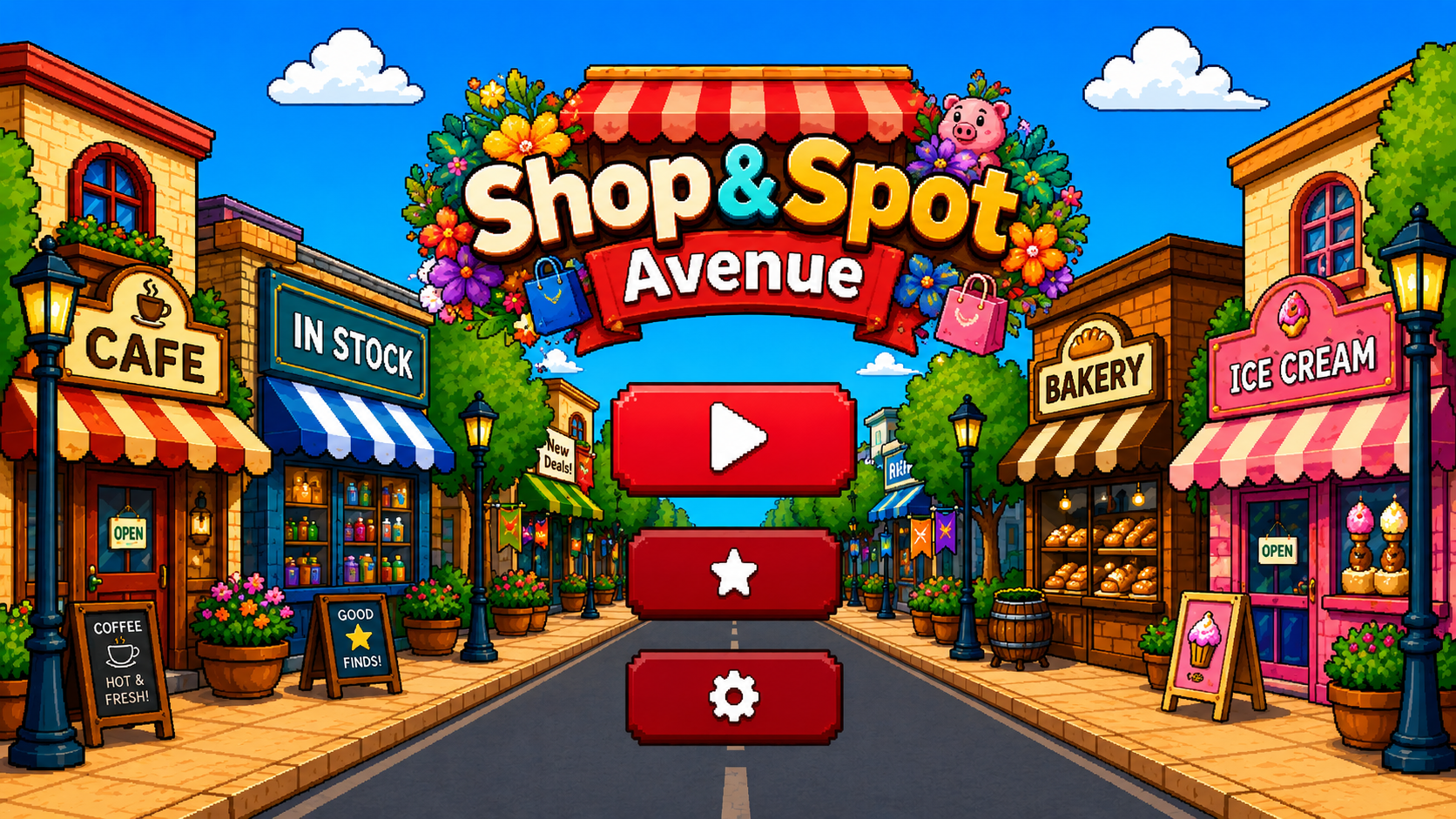
As it is with these smaller games, the main menu only consists of three choices. The first is to start playing the levels from level 1 to 30 in ‘Casual Mode’, with the option to revisit any previously unlocked level to replay.
The second option is to play any level (all are already unlocked) in ‘Challenge’ Mode which rates your speed and observation skill with a rating or one to three stars, with 90 stars to collect in total across the mode.
Finally, we have the ‘Settings’ option which allows you to turn the ‘SFX’ and ‘Music’ on and off and shows the controller layout for the game such as cursor movement, menu navigation and input. Basically, nothing too in-depth is needed for a simple gameplay loop such as this game offers.
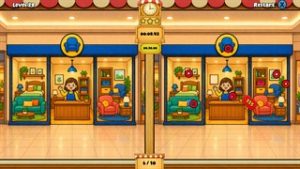
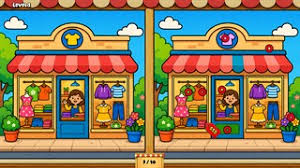
The game begins on the first level with two near identical extremely colourful pictures shown side by side. On much closer inspection though, you’ll find the right-hand picture has ten subtle differences to the left. Your mission, should you choose to accept it, is to find those ten differences per level to progress. Simple enough.
Each scene is a static image that’s not only colourful but packed with detail. This is both a good and bad thing in a spot the difference game. However, if the pictures were simple, were would the challenge be? But as a point to note, the game allows you to skip levels by simply holding down ‘Y’ for a few seconds to move on, which still unlocks the level-based Achievements. Why you would want to do this and rob yourself of the gameplay experience though, is something to consider. Why play a game not to play it?
Some differences are obvious with others, especially in the later levels, requiring carefully scanning the scene for the smallest difference as you hunt for one last difference. Leading to the best option to sometimes just randomly clicking all over the right-hand picture with the cursor until a red circle appears and you move on. Fortunately, the area space around a difference to click to ‘find’ the difference is quite generous. No need for pixel perfect, ahum, ‘spot on’ precision here thankfully. And the difference is then marked by a large red ring.
Speaking of the cursor. It’s speed and movement is surprisingly slick and responsive compared to previous games of this type and is dressed up as a little price ticket icon to further match the look of the game. However, the game doesn’t seem to have a ‘zoom’ function as an option which I personally think would be a good feature to include.
Small note, you can only press and select differences on the right-hand picture to find the differences. As the game subtly tells you to by putting a big, massive ‘X’ over the left-hand picture if you attempt to click on it. This doesn’t affect the gameplay in any way, shape, or form but it’s a nice touch from the developers to put in.
Presentation
When you load the game up, the colourful visuals are the first thing you’ll notice. The game has a very ‘young’ feel to it, which is ideal for this sort of videogame I suppose but for more serious and hard-core gamers that might initially be off-putting. However, if you was one of those sorts of gamers, why would you be playing a title such as this? The simple, single screen levels are well drawn and full of detail of the residents of the Avenue and their stores. Each level is unique in terms of what type of store it is too.
With only 30 levels though, the game will not take someone with a relatively keen eye long to get through. And afterwards, when all levels are done, there’s no real point to replay the levels again, unless you’re going for three stars in the ‘Challenge’ Mode I mentioned earlier. Repetition in these games is always going to either be a big plus to the player based on their own view, or be a major downside with these kind of games.
The music during gameplay is a simple, jingle on a loop which can eventually start to grate. Fortunately, you can turn it off for just the SFX alone. Speaking of the SFX, it consists mainly of a simple ‘blip’ when you spot a difference. That’s pretty much it.
The Bottom Line
As far as spot the difference games go, Shop & Spot Avenue is nothing new or groundbreaking. With this title you’re getting exactly what it says on the description on the Xbox Store. Easy to pick up and get into, with a very colourful visual style that’s obviously designed for the younger and more casual gamer.
Simple, straightforward and none apologetic in terms of how you play. This title really isn’t trying to reinvent the wheel when it comes to this type of game, but for only £3.29 at the time of this review, it offers a few hours of relaxing entertainment and simple paced gaming goodness.
Overall
-
CX Score - 60%60%
Summary
Pros
- Colourful and charming visuals
- Pick up and play gameplay
- Easy Completion and Gamerscore
- Great to challenge your observation skills
Cons
- Only 30 levels that you can breeze through pretty quick with a skip option
- No change in gameplay
- Zero replayability
- Very young visual style that won’t appeal to everyone