


There is something wonderfully refreshing about a football game that knows exactly what it wants to be. Beat The Champions has absolutely no interest in trying to recreate the realism, tactical depth or endless statistics of the modern football giants. Instead, it looks backwards, towards a time when football games were about picking up a controller, kicking someone into the advertising boards, scoring ridiculous goals and laughing at whatever had just happened on screen. It is football stripped back to its arcade roots, and while that approach works surprisingly well in short bursts, Beat The Champions does eventually reveal that there is only so much mileage to be found in its deliberately simple formula.
From the moment you step onto the pitch, the game’s intentions are obvious. This is fast, chaotic and deliberately over the top, with matches built around speed, aggressive challenges and special abilities rather than carefully constructed passing moves. There is very little interest in slowing things down, and that gives Beat The Champions an energy that makes the opening few matches particularly enjoyable. You can be attacking one second and desperately trying to recover from a brutal challenge the next, with possession constantly changing hands and chances appearing almost out of nowhere.
That sense of chaos is helped enormously by the decision to remove most fouls from the game. Outside of the penalty area, you can throw yourself into challenges with very few consequences, turning midfield into something resembling a football-themed battle arena. It sounds ridiculous on paper, and it is, but it fits the game’s arcade personality perfectly. There is a real sense of satisfaction in timing a perfectly placed tackle, particularly when you stop an opponent who is lining up one of the game’s more spectacular attacks.
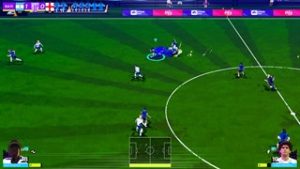
Those special abilities are at the heart of Beat The Champions. Rather than relying solely on conventional shooting and passing, players can build towards powerful moves that can dramatically change the flow of a match. These range from spectacular shots to abilities that help players burst past opponents or perform exaggerated challenges, and learning when to unleash them becomes part of the fun. The system is simple enough that you can understand it almost immediately, but there is enough timing involved to make you feel that you are gradually getting better at using it.
It is also here that the game starts to demonstrate both its strengths and weaknesses. The abilities are entertaining, particularly when playing against friends, but they can become repetitive after you’ve seen the same effects and animations several times. Some abilities also feel considerably more useful than others, meaning that once you understand what works, there is a temptation to fall back on the same tricks. Beat The Champions is at its best when everyone is experimenting, making mistakes and laughing at the madness, rather than when players begin trying to optimise every aspect of the system.

The actual football underneath all of this is surprisingly accessible. Passing is straightforward, movement is responsive and shooting feels suitably punchy, meaning that you don’t need to spend hours learning complicated controls before you can enjoy yourself. That simplicity is one of the game’s biggest strengths because it makes Beat The Champions incredibly easy to pick up. You can hand a controller to someone who has never played it before and, within minutes, they will be competing for possession and attempting to fire the ball into the top corner.
There is a reasonable selection of ways to play too, with quick matches, tournaments, leagues and the International Cup providing different ways of putting the game’s mechanics to work. The International Cup is naturally the mode that feels most relevant given the timing of the game’s release, and it provides a simple progression through a series of matches that gradually raises the stakes. It isn’t especially deep, but then depth isn’t really what Beat The Champions is trying to deliver. It is more about getting into a tournament, playing a few games and seeing how far you can go.

The biggest star of the show, however, is undoubtedly local multiplayer. Beat The Champions feels considerably more alive when you have other people sitting beside you. With support for up to four players locally, it becomes the sort of game that can turn a quiet evening into a surprisingly competitive session, particularly when a last-second goal or ridiculous special move changes everything. There is something wonderfully old-school about that experience, and it is probably the closest the game gets to recreating the feeling of sitting around an arcade machine with friends.
The official Argentine Football Association licence is another nice touch. Having access to historic Argentine squads and legendary names gives the game a little extra personality, particularly for football fans who will immediately recognise some of the game’s biggest stars. Seeing players such as Messi, Maradona and Batistuta thrown into this exaggerated arcade environment is a fun idea, and it adds a sense of occasion to what could otherwise feel like a very generic collection of international teams.
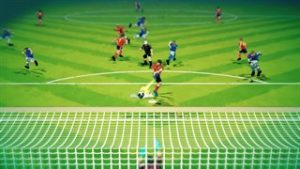
Unfortunately, the further you move away from those headline features, the more obvious Beat The Champions’ limitations become. The game simply doesn’t have the depth to sustain the same level of excitement over a long period of time. There is no substantial player development system, little reason to keep returning once you’ve worked through the available competitions, and the basic gameplay loop remains largely unchanged regardless of which mode you choose.
That isn’t necessarily a problem if you approach Beat The Champions as a party game, but it does make the single-player experience feel considerably less compelling. Against the AI, the initial excitement of the arcade mechanics can gradually turn into repetition, particularly once you have figured out how to exploit certain moves and understand the patterns of your opponents. The three difficulty levels help, but they don’t fundamentally change the underlying experience.

There are also areas where the presentation could have received a little more polish. The colourful, cartoon-inspired visuals fit the tone nicely, but some animations are stiff and certain menus feel less refined than they should. Small details, such as the presentation of player names and information in team management screens, can also make the game feel rough around the edges. None of this destroys the experience, but it does reinforce the feeling that Beat The Champions is a smaller-scale arcade title rather than a fully realised football package.
And that is ultimately where I land with Beat The Champions. There is a genuinely enjoyable game here, particularly if you have a couple of friends nearby and want something that doesn’t take itself remotely seriously. The speed, exaggerated abilities, aggressive challenges and wonderfully chaotic matches create plenty of memorable moments, and there is a real charm in the way it tries to bring back the spirit of arcade football.
The problem is that once the novelty begins to wear off, there isn’t quite enough underneath it to keep you coming back indefinitely. Beat The Champions is much easier to recommend as a game to dip into for a few matches than something you will be playing every night for months.
Final Verdict
Beat The Champions is a throwback to a simpler kind of football game, and for the most part, that is exactly what makes it enjoyable. It doesn’t want to simulate football; it wants to turn football into an arcade playground, and when you’re sitting with friends, it can be an absolute blast.
Unfortunately, that same simplicity ultimately limits its longevity. There simply isn’t enough variety or depth to make this a long-term football obsession, and the lack of online multiplayer feels like a particularly significant omission in 2026.
For a quick blast of chaotic football with friends, though, Beat The Champions has plenty to offer. Just don’t expect it to keep you on the pitch forever.
Overall
-
CX Score - 70%70%
Summary
Pros
- Fast, accessible arcade football
- Excellent local multiplayer for up to four players
- Special abilities create plenty of chaotic moments
- Historic Argentine squads add personality
- Easy to pick up and play
Cons
- Limited long-term depth
- Special abilities can become repetitive
- Single-player lacks the same excitement as local multiplayer
- Presentation can feel rough around the edges
- No online multiplayer