

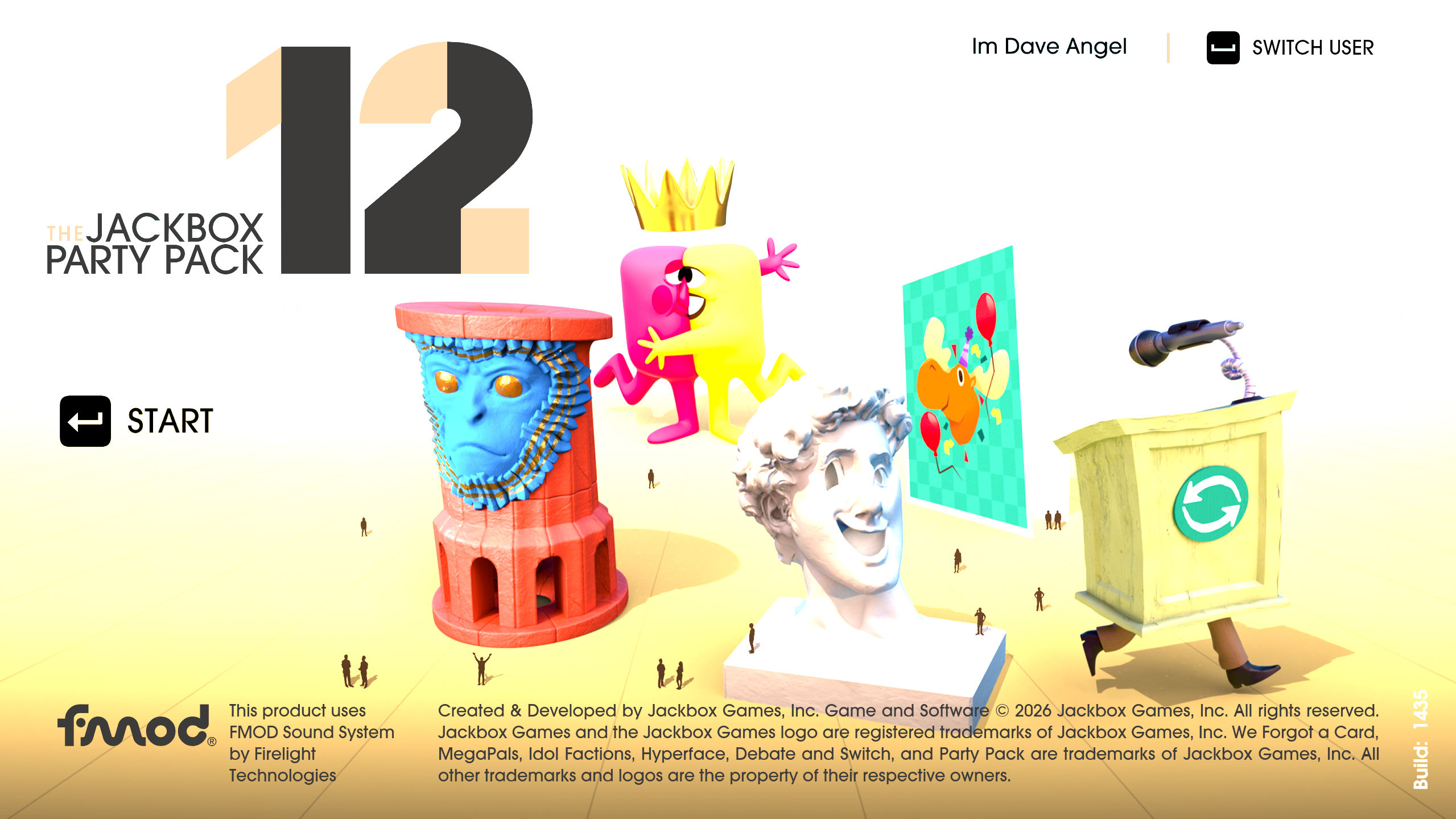
Developed/Published: Jackbox Games
Played on Xbox Series X
Tested with 6 Players
For over a decade, Jackbox Games has held an absolute monopoly on the digital party game landscape. What started as a clever evolution of You Don’t Know Jack grew into an annual tradition—a seasonal release that gaming groups, family gatherings, and live-streamers relied on to fuel their social nights. However, in recent years, a subtle fatigue began to creep into the series. Releases started leaning heavily on safe iterations: Quiplash 3, Tee K.O. 2, Drawful Animate, and a steady stream of trivia variations.
The Jackbox Party Pack 12 arrives with a clear mandate to shatter that safety net. For the first time in several mainline iterations, the developers committed to a line up built entirely on brand-new concepts. There are no direct sequels, no remastered legacy titles, and no easy fallbacks. It is an ambitious risk, and while the brave direction earns immense respect from critics and casual players alike, the actual playability across its five mini games creates one of the most polarizing compilations in the franchise’s history.
Breaking Down the Roster
To understand where Pack 12 succeeds and where it stumbles, one must look at how each of the five titles operates under the pressure of a real room full of players.
MegaPals
If Pack 12 has a crown jewel, it is unequivocally MegaPals. Positioned as the quintessential icebreaker, the game operates on a fast-paced word-association engine where players attempt to synchronise their top-of-mind responses with one another. Unlike games that rely on cutthroat competition or elaborate joke writing, MegaPals thrives on collective mind-reading.
The brilliance of MegaPals lies in its accessibility. The barrier to entry is virtually zero, making it an instant hit with casual groups, multi-generational family nights, and large crowds. It captures the rapid-fire energy that made classic Jackbox games so enduring, proving that simple mechanics paired with tight timing often yield the highest entertainment value.

Hyperface
Taking up the mantle of the designated “drawing game,” Hyperface trades traditional sketching tools for absurd, photo-warping mechanics. Players use their phone screens to manipulate, distort, and mash together visual elements based on ridiculous prompts.
At launch, Hyperface met some resistance due to a steep initial learning curve on mobile web browsers. Mobile touch controls occasionally feel imprecise when trying to pull off fine visual tweaks. However, once players accept the chaotic nature of the UI, the resulting visual comedy is undeniable. It may not match the timeless art-house madness of Tee K.O., but it succeeds in turning mobile screens into digital funhouse mirrors.
We Forgot a Card
A hybrid prompt-and-matching card game, We Forgot a Card attempts to combine greeting card aesthetics with Quiplash-style fill-in-the-blank humour. Players write custom messages for oddly specific or inappropriate social occasions, which are then read aloud by robotic text-to-speech narrators.
While the game reliably generates chuckles—thanks in large part to the deadpan delivery of the synthetic voices—it suffers slightly from identity overlap. Longtime fans will quickly spot the underlying mechanics of past prompt-driven text games. It serves as a comfortable, middle-of-the-road entry that fills out the pack without necessarily reinventing the wheel.
Idol Factions
Injecting a dose of direct competition, Idol Factions presents a fast-paced, team-based trivia format inspired by old-school game show rounds. Players are split into opposing groups, battling for territory and points by agreeing on quick-fire factual answers.
Idol Factions is a hit for groups that enjoy frantic debate over trivia, but its design choices limit its versatility. With smaller player counts (3 to 4 players), the team dynamic breaks down, leaving the pacing feeling sparse. It thrives in a full room of 6 to 8 people but struggles to maintain that high energy when scaled down.

Debate and Switch
The most talked-about—and deeply flawed—addition to Pack 12 is Debate and Switch. Designed as an unscripted argument game, players write custom topics, swap key terms behind their opponents’ backs, and are then forced to defend outlandish or contradictory positions on the fly.
On paper, the premise sounds like a recipe for comedic gold. In practice, it highlights the biggest structural issue in modern party game design: the danger of an undefined sandbox.
The Anatomy of a Misfire: Why Debate and Switch Splits the Room
The core complaint surrounding Debate and Switch from press reviews, board game enthusiasts, and casual players boils down to a lack of proper instruction and mechanical guardrails.
Party games require a delicate balance between player freedom and structured rules. When a game offers too little guidance, it places the entire burden of entertainment onto the players themselves. Debate and Switch drops players into an open arena with minimal direction on how to construct a compelling argument or how rounds are definitively scored.
When compared to Talking Points (from Jackbox Party Pack 7), which provided structured slide decks and concrete roles for speechmakers and co-pilots, Debate and Switch feels unguided.
Without strict parameters:
- Rounds frequently stall: Introverted or unprepared players are left stranded on the mic without helpful prompts to lean on.
- Tonal whiplash: Prompts created by one player often clash with the comedic style of another, leading to awkward silences rather than witty banter.
- Social friction: Because prompt generation is entirely wide-open, casual games can quickly veer into divisive real-world arguments or uncomfortably mean-spirited debates if the group isn’t carefully curated.
Compounding this lukewarm reception is an industry controversy that surfaced shortly after the pack’s reveal. Indie tabletop designer Ben Pinchback publicly noted striking mechanical similarities between Debate and Switch and his physical card game prototype, Die On This Hill, which had previously been pitched to publishers. While Jackbox Games maintained that the title was developed independently in-house, the narrative added another layer of cloud over the game’s release.
(Note to Ed…. Not sure if you want to include this paragraph but my research indicates it was an issue that Jackbox had to negotiate – T )
The Media and Public Consensus
The Jackbox Party Pack 12 sits at an average score of 7.5 out of 10 out on the eddies of the Internet. Critics commend the studio for refusing to rely on easy sequel money, noting that an experimental pack with mixed results is far preferable to a boring, predictable safe bet.
Public reaction follows a similar curve and seems to follow my opinion of the offerings in JPP 12.
Now, this pack has been quite polarising for our group of players. All have loved the highs of Megapals and Idol Factions, but Debate and Switch has left us all completely dumbfounded and lost. if your group prefers clear-cut trivia or guided fill-in-the-blanks, half the pack may end up left on the shelf. Which is a shame, as I am sure a quick-thinking group with better mental agility than us would be able to have some entertaining tussles.
Final Thoughts
The Jackbox Party Pack 12 stands as a noble, albeit slightly flawed, entry in the long-running series. By delivering five completely original titles, Jackbox Games proved it still has the appetite for innovation. While mechanical vagueness holds Debate and Switch back from greatness, the overall collection provides enough genuine laugh-out-loud moments to justify its place on the virtual tabletop.
Overall
-
CX Score - 70%70%
Summary
Pros
- 100% Original Roster: Zero retreads, remakes, or sequels. Every single game is a brand-new concept, which is a refreshing change of pace after several packs relied heavily on iterative sequels.
- Instant Crowd-Pleaser in MegaPals: The word-association mechanics are intuitive, fast-paced, and accessible to anyone regardless of gaming experience or age.
- Absurd Visual Comedy in Hyperface: Once you get past the initial learning curve, using mobile screens to warp and distort photos leads to some of the funniest visual moments in the pack.
- Great High-Energy Trivia with Idol Factions: In a full room of 6 to 8 people, the team-based territory battles offer great competitive trivia energy reminiscent of old-school game shows.
- Bold Experimental Design: Following along on the success of “Legends of Trivia” in Jackbox Party Pack 11, Jackbox games could have playing it safe with predictable formulas. The pack actively pushes into new mechanics like unscripted open arguments and phone-based photo manipulation.
Cons
- Undirected Mechanics in Debate and Switch: The lack of strict scoring guardrails or structural guidance leaves players stranded, often causing rounds to stall or fall into awkward silences.
- High Social/Performance Pressure: Games like Debate and Switch depend entirely on how naturally funny or talkative your group is; quiet or introverted players can easily feel put on the spot.
- Uneven Scalability: Idol Factions requires a large group to shine, losing its team dynamic and fast pace when played with only 3 or 4 people.
- Fussy Mobile Controls for Drawing/Warping: Precision touch controls in Hyperface can feel cumbersome on smaller screens or mobile browsers during high-pressure rounds.
- Familiarity Overlap in Text Games: While We Forgot a Card brings fun text-to-speech voiceovers, its underlying prompt-and-match structure can feel a bit derivative of past fill-in-the-blank titles like Quiplash.