

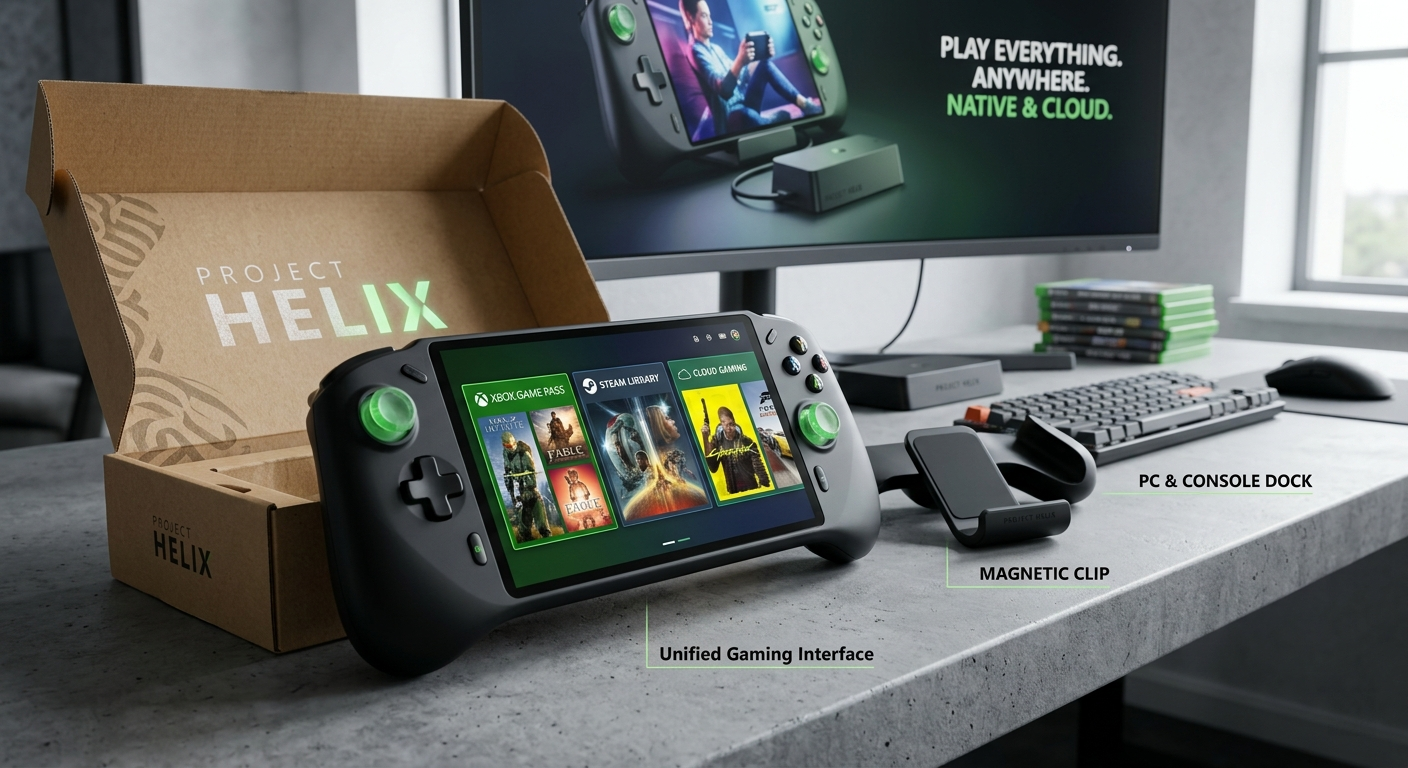
For more than two decades, Xbox has lived in two worlds. One was the living-room console ecosystem built around simplicity, exclusives, and plug-and-play convenience. The other was Windows gaming – open, customisable, and technically limitless. Project Helix appears designed to erase the line between them.
According to Microsoft’s early statements, executive interviews, developer presentations, and industry reporting, Project Helix is shaping up to be far more than a traditional Xbox successor. It is being positioned as a hybrid gaming platform: part console, part gaming PC, and potentially the foundation for Microsoft’s next decade of gaming strategy. Here’s what we think that might entail:
A New Kind of Xbox
The headline feature of Project Helix is simple but disruptive: it will run both Xbox games and PC games. Microsoft executives have repeatedly confirmed this point, framing Helix as a convergence device rather than a conventional closed console.
That could mean:
- Native support for Xbox console libraries
- Access to Windows PC games
- Integration with Xbox Play Anywhere
- Possible compatibility with storefronts beyond the Microsoft Store
- A unified ecosystem between console and PC players
If Microsoft delivers on that promise, Helix may become the first major console designed around openness instead of exclusivity, although new head CEO of Xbox has already toyed with the idea of being exclusive focussed on its game selection.
The comparison many analysts and fans are already making is to the Steam Deck – but scaled up into a full living-room platform. Reddit discussions surrounding the reveal repeatedly describe Helix as “a PC that feels like a console.”

The Hardware: AMD, AI, and “FSR Diamond”
Microsoft has officially confirmed that Project Helix uses a custom AMD system-on-chip built around next-generation CPU and GPU architecture. Reports point toward AMD Zen 6 CPU cores and RDNA 5 graphics technology, although final specifications remain unannounced.
The larger story is what Microsoft plans to do with AI-assisted rendering, which has been hotly criticised recently particularly on DLSS from Nvidia.
Helix is expected to heavily integrate AMD’s new “FSR Diamond” technology stack, an advanced suite of machine-learning rendering tools that reportedly includes:
- AI upscaling
- Neural rendering
- Multi-frame generation
- Ray reconstruction
- Advanced texture compression
- Improved path tracing performance
Microsoft claims the hardware could deliver an “order of magnitude” leap in ray-tracing performance over current Xbox systems.
If accurate, that would represent the biggest graphical leap Xbox has attempted since the Xbox 360 era, although we are unlikely
Industry watchers also believe AI acceleration hardware will play a central role in Helix’s architecture. Some leaks suggest dedicated neural processing components could support rendering, background system tasks, and future Xbox platform features.

“Xbox Mode” could be the secret weapon
One of the most intriguing features tied to Project Helix may not actually live inside the console itself. Microsoft has announced an upcoming “Xbox Mode” for Windows 11 – a gaming-focused interface designed to deliver a more console-like experience on PC hardware. This matters because Helix increasingly sounds less like a fixed console and more like a specialized gaming PC wrapped in Xbox software.
If Xbox Mode succeeds, Helix could offer:
- Console simplicity
- PC flexibility
- Unified game libraries
- Shared saves and ecosystems
- Cross-device continuity
The strategic goal seems clear: Microsoft no longer wants “Xbox” to describe a single box under a TV. It wants Xbox to become a gaming platform layer spanning console, PC, cloud, and handheld devices simultaneously.
Backward Compatibility remains core
Microsoft has emphasised that backward compatibility remains central to its next-generation strategy. Executives have stated the company is committed to keeping four generations of Xbox games playable into the future.
That likely means Helix will support:
- Xbox One games
- Xbox Series X|S titles
- Large portions of the Xbox 360 library
- Original Xbox backward-compatible titles
Preserving digital libraries has become increasingly important to Xbox users, and Microsoft appears determined to make continuity a competitive advantage against Sony and Nintendo.
Could Steam and Epic Games arrive on Xbox?
This is the question generating the most speculation. Microsoft has not officially confirmed Steam or Epic Games Store integration. However, the company’s messaging around PC compatibility has fuelled widespread expectations that third-party storefronts could eventually work on Helix hardware.
If that happens, Helix would fundamentally redefine what a console is. No console manufacturer has fully embraced that level of openness before.

The risks Microsoft faces
Project Helix also carries enormous risks.
Potential concerns include:
- High launch pricing
- Hardware complexity
- Developer optimization challenges
- Consumer confusion
- Competition from gaming PCs and handhelds
- Questions about exclusives
Some fans already worry Helix could become “a Steam Machine with an Xbox logo.”
That criticism highlights the challenge ahead for Microsoft: if Helix is too much like a PC, consumers may simply buy PCs instead.
When will Project Helix launch?
Microsoft says developer alpha hardware should begin shipping in 2027. Analysts therefore expect a consumer launch sometime in late 2027 or 2028. More details are expected later this year, according to Xbox executive Jason Ronald.